Users
Social media
- More details here...
- Address
Parc Científic de la Universitat de València C/
Catedrático Agustín Escardino, 9
46980 Paterna (Valencia) Spain - Email:
iu.i2sysbio@uv.es - Phone:
(+34) 963544810
- Address
Links


Users
Social media
Parc Científic de la Universitat de València C/
Catedrático Agustín Escardino, 9
46980 Paterna (Valencia) Spain
(+34) 963544810
Links

Investigation
The Environmental and Biomedical Virology Group at the Institute for Integrative Systems Biology (I2SysBio), a joint centre of the Spanish National Research Council (CSIC) and the University of Valencia (UV), has led the treatment of a patient who, after sustaining serious injuries during an armed conflict and undergoing several surgical procedures, developed an infection caused by multidrug-resistant Klebsiella pneumoniae. The treatment, based on personalised therapy using a bacteriophage in combination with colistin, succeeded in eliminating the bacteria, promoting wound healing and partially restoring mobility to the elbow, thereby avoiding an amputation that had been proposed by the medical team because of the risk of the infection spreading to the bloodstream. The study, carried out in collaboration with the General Defence Hospital in Zaragoza, has been published in the International Journal of Infectious Diseases.
Armed conflicts can result in a high number of casualties who, when faced with limited access to healthcare services, a shortage of resources or delays in treatment, are at greater risk of developing persistent infections caused by multidrug-resistant bacteria. These infections are particularly complex when they affect deep wounds, bones, implants or prostheses, as they can limit treatment options and require prolonged treatment or further surgical procedures.
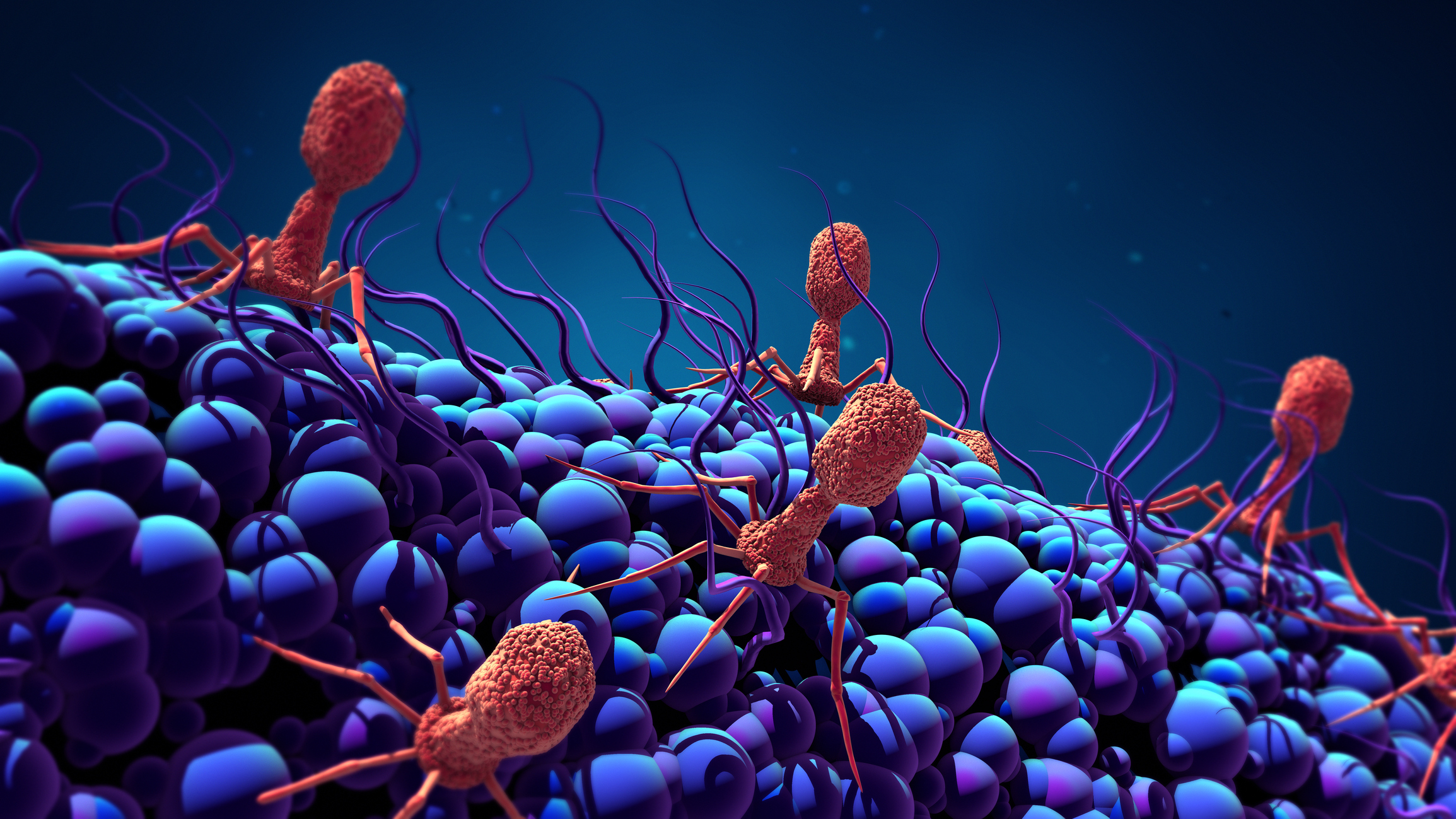
Bacteriophages – viruses capable of specifically infecting and destroying certain bacteria – are gaining attention as a complementary tool against this type of infection. This specificity allows treatments to be tailored to each individual infection and combined with antibiotics and surgical interventions. Although phage therapy is still in the clinical development phase, these treatments could offer new alternatives when conventional therapies prove insufficient.
This study describes the treatment of a 52-year-old man who, in 2022, sustained serious injuries during armed conflict and who, following several surgical procedures, developed a multi-drug-resistant K. pneumoniae infection. The infection persisted despite the antibiotic treatments administered, prompting the medical team to seek an alternative treatment to avoid amputation of the limb.
In this context, the medical team turned to I2SysBio researcher Pilar Domingo Calap, whose team selected and characterised a bacteriophage active against the bacterium isolated from the patient, as well as producing it for therapeutic use. The personalised therapy, authorised by the Spanish Agency for Medicines and Health Products (AEMPS) under a compassionate use scheme, combined the intravenous and local administration of the bacteriophage with colistin.
The response to treatment was rapid: K. pneumoniae was no longer detected in the wound samples by the eighth day, and subsequent tests remained negative. Furthermore, progressive wound healing and a partial recovery of elbow mobility were observed. Clinical improvement was maintained during follow-up, and no treatment-related adverse effects were observed.
This case highlights the potential of personalised phage therapy as a complementary treatment for complex infections caused by multidrug-resistant bacteria. At the same time, it underlines the need to continue developing clinical studies to evaluate its efficacy and establish protocols for its application in clinical practice.
The project was funded through crowdfunding in collaboration with the Spanish Cystic Fibrosis Foundation, Project SEJIGENT/2021/014 (Regional Ministry of Innovation, Universities, Science and Digital Society; Valencian Regional Government), Project PID2020-112835RA-I00, the Ramón y Cajal contract RYC2019-028015-I, and grant FPU19/04611 (Ministry of Science, Innovation and Universities).
Reference: Lucas Mora-Quilis, Mireia Bernabéu-Gimeno, Marco Pardo-Freire, Sergio García-Porto, Valentín Yuste-Benavente, María del Mar Rodero-Roldan, Pilar Domingo-Calap. Favourable clinical and microbiological outcomes of a war-associated prosthetic joint infection caused by Klebsiella pneumoniae treated with combined phage-colistin therapy. International Journal of Infectious Diseases. DOI: 10.1016/j.ijid.2026.109079