
Users
Social media
- More details here...
- Address
Parc Científic de la Universitat de València C/
Catedrático Agustín Escardino, 9
46980 Paterna (Valencia) Spain - Email:
iu.i2sysbio@uv.es - Phone:
(+34) 963544810
- Address
Links


Users
Social media
Parc Científic de la Universitat de València C/
Catedrático Agustín Escardino, 9
46980 Paterna (Valencia) Spain
(+34) 963544810
Links

Investigation
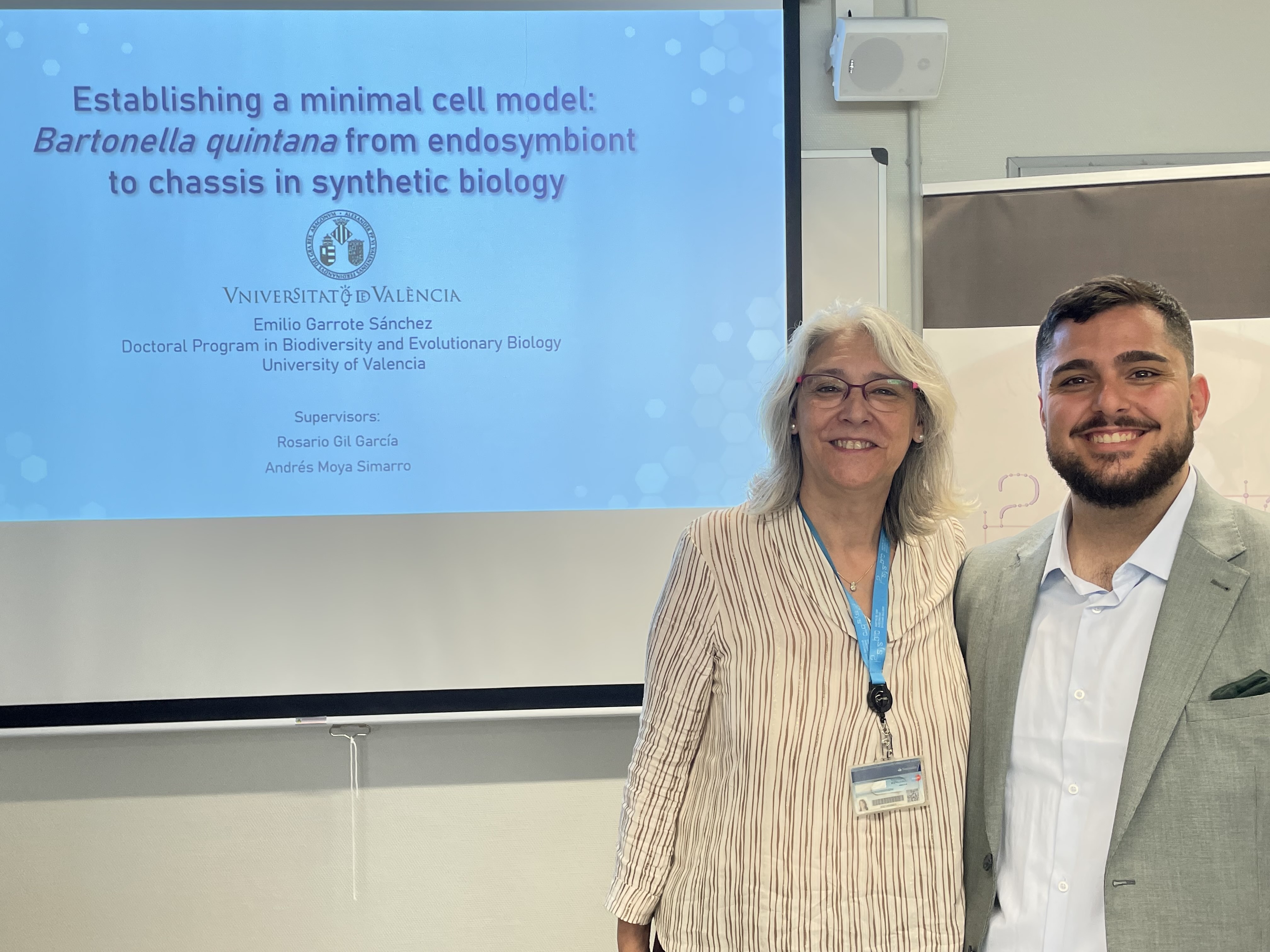
In this thesis, supervised by Rosario Gil and Andrés Moya, the endosymbiotic bacterium Bartonella quintana has been evaluated as a minimal cell model for synthetic biology through genomic analysis, metabolic modelling and integrated experimental validation. Part of the results were published in Frontiers in Bioengineering and Biotechnology. The thesis was defended on 24 April 2026.
Synthetic biology requires well-characterised organisms that allow for predictable behaviour. The thesis entitled “Establishing a minimal cell model: Bartonella quintana from endosymbiont to chassis in synthetic biology” explores the bacterium B. quintana as a potential cellular chassis due to its reduced genome and compact architecture, although its slow growth and limited understanding have so far hindered its use. To tackle the research, an integrated strategy was applied combining genomic resequencing, metabolic modelling, selection of dispensable genomic regions and experimental validation. Firstly, a high-quality reference genome sequence was obtained via long-read sequencing, correcting previous errors and improving functional annotation. This enabled the identification of non-essential regions and a more precise definition of which parts of the genome are essential or dispensable. Based on this analysis, deletions were designed using bioinformatics tools and attempts were made to implement them experimentally, although some proved unstable. Furthermore, a genome-scale metabolic model was constructed, revealing a strong dependence on external nutrients, such as amino acids, the haem group and vitamins. The model’s predictions were evaluated through growth and proteomics assays, yielding consistent results that were, however, affected by experimental variability. Taken together, this study establishes a solid foundation for developing B. quintana as a chassis and proposes a methodology applicable to other, more complex microorganisms.
Emilio Garrote carried out his doctoral research in the Evolutionary Genetics group at the Institute for Integrative Systems Biology I2SysBio (UV-CSIC) under the supervision of Rosario Gil and Andrés Moya, both professors of genetics at the University of Valencia and I2SysBio researchers. During his research, Emilio Garrote undertook a visit to the Department of Cell and Molecular Biology at Uppsala University, under the supervision of Siv Andersson. He also held a contract under the University of Valencia’s Atracció de Talent Programme. The examination board consisted of Christina Toft (CSIC, I2SysBio), Rafael Patiño Navarrete (Institut National de la Santé et de la Recherche Médicale, INSERM), and Juli Peretó (UV, I2SysBio), who awarded the thesis a grade of ‘outstanding’.