
Users
Social media
- More details here...
- Address
Parc Científic de la Universitat de València C/
Catedrático Agustín Escardino, 9
46980 Paterna (Valencia) Spain - Email:
iu.i2sysbio@uv.es - Phone:
(+34) 963544810
- Address
Links


Users
Social media
Parc Científic de la Universitat de València C/
Catedrático Agustín Escardino, 9
46980 Paterna (Valencia) Spain
(+34) 963544810
Links

Investigation
A study from the Institute for Integrative Systems Biology (I2SysBio), a joint center of the Spanish National Research Council (CSIC) and the University of Valencia (UV), demonstrates that Escherichia coli bacteria, which inhabit the human gut and are highly relevant to health, grow in predictable ways following the laws of physics after exposure to antibiotics. The results, published in Nature Communications, highlight the role of mechanical forces and cellular geometry in bacterial division processes and open new avenues for understanding microbial behavior and developing more effective antibiotic treatments.
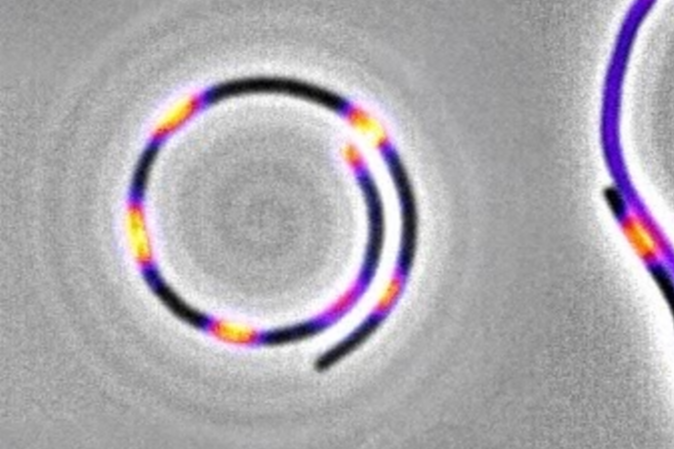
When exposed to stress conditions such as antibiotics, bacteria can interrupt their cell division and begin to grow as filaments. This bacterial resistance mechanism, known as “filamentation,” is frequent in infections such as urinary tract infections. Filamentous growth generates mechanical stresses that bend and deform the filaments. The study, led by I2SysBio researcher Javier Buceta, shows that these bacteria curve in predictable ways that follow physical laws. “This behavior is not random; it follows a well-defined mechanics that regulates how tension is distributed in the cell as it grows,” explains the CSIC researcher.
The work focuses on antibiotic-induced filamentation and demonstrates, for the first time in filamentous bacteria such as E. coli, that curvature not only affects the external structure of the cell (its shape) but also modifies key biological processes essential for survival and behavior. For example, changes in cell shape alter the activity of a protein network called Min, which “scans” the cell to determine the correct division site.
Using a multidisciplinary approach, the study shows that in regions of higher curvature there is a lower concentration of DNA and of the MinD protein, as well as greater activity of the division machinery. “This phenomenon, which links biological responses with mechanical behavior, is related to transport processes inside the cell, since curvature modifies how proteins move and cluster in the cell membrane. This is the first demonstration of a mechanobiology effect in filamentous bacteria,” says Buceta.
In this context, the study shows that once the stress disappears, the cell tends to divide at the points of maximum curvature, indicating that it retains a “trace” of the stresses it experienced. This “mechanical memory” acts as an internal marker that guides future divisions when conditions become favorable again.
Regarding the implications of these findings, PhD student and first author of the article, Marta Nadal, explains: “This mechanobiological perspective opens new research directions in biomedicine, where therapies could be designed to interfere with bacterial physical or structural properties.” “Moreover, understanding how bacteria retain a ‘memory’ of adverse situations may be crucial for anticipating their behavior after antibiotic treatments, helping to prevent relapses or resistance. In the field of public health, this knowledge could be applied to designing strategies for controlling persistent or recurrent infections, especially in the context of rising antibiotic resistance,” Nadal adds.
“Our work goes beyond traditional biochemical mechanisms and shows that physics is a key driver of bacterial division,” says Iago López Grobas, a ‘Marie Curie’ postdoctoral researcher in the group and co-leader of the study. “In essence, we add a new piece to the puzzle: the physical shape of the bacterium is not just a consequence of its growth but an active signal that guides its fate. This is crucial for understanding how bacteria divide effectively even under adverse conditions, knowledge that can be harnessed to develop strategies that disrupt this process and overcome resistance,” he adds. “We are intrigued to explore whether other physical stimuli in the environment, such as electric fields or additional mechanical forces, can also induce similar alterations and ‘memories’ in the division process. Our goal is to create a complete map of how bacteria integrate physical signals from their environment to make cellular decisions, opening the door to new strategies for fighting infections,” concludes López Grobas.
Filamentation is a key bacterial survival mechanism when they begin forming biofilms—structured communities of bacteria that adhere to surfaces and have negative impacts across multiple sectors such as health and the food industry. “Understanding how cell mechanics determine filament shape and behavior could help design more effective materials to prevent or control biofilm formation,” says Buceta. “For example, manufacturing catheters with structural properties that interfere with bacterial filamentation and destabilize incipient biofilms locally,” he concludes.